Happy Birthday, Pablito!

(monologue in three paragraphs)

Pablito as harlequin?
cut out each strip & collect ART!

H A P P Y  B I R T H D A Y,  P A B L I T O !  You would have been 71 years old today, May 5th. But you chose to end your life prematurely, at 24. I’m glad your sister Marina was with you when you died. She took care of you, like all sisters do, right? I heard that one of the most terrible blow that parents experience is witnessing their child die before they die—your father passed away two years after you did. He drank himself to death.

So many questions to ask you! How does it feel to be the grandchild of a famous artist? How do you feel about being named after your grandpa? Did you have any of his works displayed at home? Did your classmates know about your grandpa? Did they understand his work? And finally, why did you really do it? Is it true that you were devastated because you couldn’t go to his funeral? Why did you do it, Pablito?

[pause – uncomfortable silence – no soundtrack]

Sorry, I shouldn’t have asked those last questions. Depression is a source of unhappiness and sometimes induces suicidal thoughts. Someone said, I think referring to the poet Sylvia Plath, that “depression is as necessary to the creative soul as sleep is necessary to the body.” Really? Some people see the premonition of suicide in van Gogh’s unfinished paintings. (Of course, he didn’t finish them.) My friend Gustav even finds traces of suicidal ennui in Janis Joplin singing Gershwin’s Summertime. So, I’ll ask again and again, Pablito Picasso (1949-1973): Why in Hell did you drink that damned bottle of bleach ? ! ?

— New York City, 5/5/2020

. . . MONAT MAI (*)

cut each strip & collect

M A Y, under normal circumstances, is
a glorious month
in NYC.

Trees are finally green. Blooms abound. People circulate freely and together as if en route to a tableau vivant of Seurat’s Grande Jatte. Do you remember that painting? It’s in Chicago, sheltering
in place now, in
a museum.

Around 100,000 people perished in London (1/4 of the city’s population) in the Great Plague of 1665. The Bill of Mortality shown here documents the week of May 19-26, 1665, and specifies all different causes of death. The Plague, alone, was responsible for 7,165 casualties out of
a total of 8,297.
— NYC, 5/2/2020

(*) month of may, as in Robert Schumann’s Im wunderschönen monat mai, from Dichterliebe, op. 48.

Poetry and Pesto

cut out each strip & make pesto!

P O E T R Y   C A N   B E   F O U N D  anywhere, even in pesto. “If the definition of poetry allowed that it could be composed with the products of the field as well as with words, pesto would be in every anthology. Like much good poetry, pesto is made of simple stuff,” says Marcella Hazan in The Classic Italian Cook Book.

While perusing cookbooks at home to prepare for self-isolation gourmet marathons, I came across a first edition of this classic, the kind of edition that lists, in the colophon, the typeface the designer chose to make everything clearer to the reader. In this case, Caledonia, “a Linotype face [that] belongs to the family of printing types called “modern faces” by printers—a term used to mark the change in style of type letters that occurred about 1800.” (The “8” is slightly raised from the rest of the numerals in what’s called old style numerals.)

My friend Gustav likes to read ingredients lists aloud as if they were haiku. Cooking terms distill poetry, like “julienned,” “bain Marie,” and the sonorous “spatchcock.” Some claim that cooking is in itself an artistic discipline, not unlike painting or writing ; that is, meal construction simulates architecture, a brush stroke structure, an adjustment of rhyme—or salt.              — New York City, 4/28/2020

– – – – – – – – – – – – – – – – – – – – – – – – – – – – – –

M A R C E L L A  H A Z A N ’ S  B L E N D E R  P E S T O
(from The Classic Italian Cook Book, Knopf, New York, 1976, p. 140)

Enough for about 6 servings of pasta
2 cups fresh basil leaves
1/2 cup olive oil
2 tablespoons pine nuts
2 cloves garlic, lightly crushed and peeled
1 teaspoon salt
1/2 cup freshly grated Parmesan cheese
2 tablespoons freshly grated Romano Pecorino cheese
3 tablespoons butter, softened to room temperature
1. Put the first five ingredients in the blender and mix at high speed. Stop from time to time and scrape the mix toward the bottom of the blender with a rubber spatula. 2. Pour mix into a bowl and beat the two grated cheeses by hand. When incorporated, beat in the softened butter. 3. Before spooning the pesto over pasta, add to it a tablespoon or so of the hot water in which the pasta has boiled.

Missing MoMA

Russian poster from the Revolution Era (circa 1920, detail) at MoMA

It was mid March. Friday. I was planning to go to MoMA —it’s open late on Fridays— when we heard that one by one, all museums in New York City were closing to avoid human congregations. That’s when we started watching online virtual tours, artists self-confessionals via YouTube, and revisited forgotten art books in our dusty bookshelves.

I hold a master in Art History from the University of Buenos Aires. I studied art through books, the works sometimes poorly reproduced. The first time I went to Europe I left no artwork unseen in all the museums I visited. Being face to face with those masterpieces was exhilarating. My promenades required meticulous planning, anticipation, and pent up joy. Now, I don’t plan ahead and prefer to be surprised at hidden corners or uninhabited rooms. It’s a reverse Holy Grail quest: there is no pilgrimage to mecca. Mecca is presented to me. By just getting off the Met elevator at a floor that somebody else picked, I have come across unforgettable treasures.

Being six feet apart from others in museums is something I cherish. When museums reopen and implement social distancing, we will enjoy each painting or sculpture at its full, not distracted by proximity. With age, I’ve become allergic to unnecessary chatter, second-hand perfume inhalation, threatening group tours, couture statements, not to mention coughing and sneezing. BTW, I haven’t seen “Starry Night” N95 face masks yet.

New York City, 4/25/2020

A Woman Rich in Talent

cut out each strip & collect

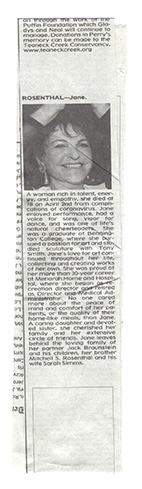
She was not a friend friend but a friend of a friend. Most people call that an acquaintance. I call it an acquaintance with echo. I remember her being dashing but not ostentatious, with a welcoming smile and a sense of humor. She lived alone in the Upper East Side with no pets that I knew of.

My husband and I still make a salmon dish that she concocted and was transmitted from hand to hand, friend to friend, kitchen to kitchen, as if it were an ancient saga that travels orally through a whole community. It couldn’t be simpler: you marinate a salmon fillet overnight with: white wine, olive oil, soy sauce and honey in equal parts, 3 cloves of garlic, 1 minced sweet onion, ground pepper, and a dash of Worcestershire sauce. Before shoving it into a 400º oven for 22 minutes, you spread fresh dill on top of the fish. When passing this foolproof recipe to us, our friend friend baptized it “Jane Susan’s Fabulous Marinated Salmon.”

The last time we saw her was at a shiva service and she still looked radiant, wearing a bright ultramarine wool coat albeit a bit more fragile, accompanied by a cane. We saw her out, as her Über driver was approaching the sidewalk. I didn’t imagine I would see her again in the obituaries section of the New York Times some Sundays ago, the smile still vibrant. Her fabulous salmon will have a different taste now.

—Walking along the Hudson River Park, 4/18/2020

Der Einsame in Herbst*

cut out each strip & collect

After a year of silence, I finally heard from my friend Gustav Bauenstadt. I know he travels a lot and finds solace in isolation to write his music essays. But his recent vanishing struck me as odd. During the confinement, I invited him to an impromptu zoom meeting.

He looked radiant and dapper, as I know him, but he proceeded to tell me that he had had a very bad year. It all started with an aborted suicide attempt that led him to a two-week hospitalization in a psychic ward near Salzburg. (I suspected he is prone to depression, like most creative people.) After long therapy sessions and medication, Gustav recovered­—slowly. Little by little he started writing again, taking walks along the nearby lake —a bit like his homophonic Gustav Mahler— and enjoying all his habitual pleasures.

I couldn’t be more happy, not only for having reconnected with him but knowing he is well and safe now. Living alone is not easy, specially when you are blue. Add a pandemic to it and the result could be catastrophic. I briefly thought —perhaps in a burst of selfishness while I was trying to adjust the volume during the zoom call— that if this happened to me, I have a wonderful husband to come home to, who would be supportive, protective, and forever loving. And a cuddly Calico cat that would welcome me after a hiatus in therapeutic limbo. Thankfully that thought left my head when Gustav shared with me some of the occupational therapy he had to undergo while in seclusion at the hospital: “Gestalt macramé,” he said in his sarcastic, accented English. I knew then, that he was back to normal.

—New York City, 4/14/2020

Illustration: Luis Pereyra, Le instante fatale…, 2007, crayon on paper. Rodriguez-Gibson Collection

* The title of the second song in Gustav Mahler’s Das Lied von der Erde (1908-09)

One Canto at a Time

cut out each strip & collect

Easter is next Sunday. Dante’s Divine Comedy, a trilogy that includes Inferno, starts on the night before Good Friday and ends after Sunday, as Dante emerges from Paradise. Literary experts calculated that Easter Sunday that year was March 25th, 1300. Dante completed his magna opus in 1321.

One of the books I chose to re-read during this pandemic is Dante’s Inferno. My plan is to ration it to one canto per day. The book contains 34 sections or cantos (technically 33 cantos preceded by an introductory one). So if I’m disciplined, I will be done in just over a month. If our quarantine continues then —which probably will— I’ll move on to Purgatory and Paradise, a meaningful total of 100 days.

As a kid I was inspired —and terrified— by Gustav Doré’s virtuosic Inferno illustrations. As a teenager I was attracted to William Blake’s quasi erotic renderings of the sufferings in Hell. But this time I will follow Dante’s text with the illustrations that Sandro Botticelli created in the 1480s. They are fresh, cinematic, comic strips without speech bubbles. Since most of them were left unfinished (uncolored), my interest focuses on the grace and dexterity of Botticelli’s lines. Lines so thoughtful.

New York City, 4/7/2020

Balconies and Bidets

Balconies and Bidets
cut out each strip & collect

Owning spacious balconies and bidets distinguishes Europeans from Americans. Isabella Rosellini recently posted in instagram (Yes, I follow her!) a photo of her bidet and added: “For years my US friends made fun of my bidet. Now that toilet paper is so hard to find is my bidet enviable?” I tried to type a Brava! followed by a heart emoji but there were 1,713 comments piled up certainly not six feet apart.

We’ve been watching heartbreaking videos of Italians singing out in their balconies to make this health crisis look more artistic and less apocalyptic. (The word “balcony” comes from the Italian balcone.) But what about Manhattan? Our co-op building lacks those precious extensions, or even Juliet balconies. I suggested that our upstairs friend Ken and my husband, both accomplished singers, start a trend of vocalizing from the open windows. (They used to sing together in an a capella group for numerous years.) We’ll see if it takes on.Balconies and Bidets

But going back to toilet paper, is it worth all this crazy hoarding? When I took a (solitary) walk last week around the neighborhood, I spotted a graffiti scribbled on a (solitary) construction site: “If this is Armageddon, why buy so much TP now: what you need clean is your conscience, not your ass.

West Village, 3/31/2020

Chance Encounters of the Art Kind

cut out each strip & collect

“Chance is another name that we give to our mistakes. And all of the best things in my films are mistakes,” said filmmaker Robert Altman in an interview.

Chance and creativity go hand in hand. Actors are stimulated by a director to improvise, finding clues out of errors, or unintentional gestures. A Chinese calligrapher creates his work in a snapping brushstroke and it looks perfect (Accidental drippings enlighten the pictogram). A songwriter bases a song on a word he or she found scribbled on a street wall. Pablo Picasso incorporated his friend Gertrude Stein’s business card onto one of his cubist paintings after she left it behind in his studio.

Theater director Jonathan Miller describes his method: “As to the actual execution of the scene, I don’t really know what I’m going to do until about 15 seconds before I start directing,” he told the New York Times in 1997. “You have to have confidence in that part of yourself of which you are not the proprietor, your unconscious. […] I know that over 40 years of reading and thinking and wishing and looking at things and keeping my eye open, I have forgotten at least 80 percent, but that somewhere inside me, it’s all there, and under the pressure of an actual occasion, it will deliver itself.”

—Raúl Rodriguez, Grammercy Park, 1.15.2019

What Does a Titi Monkey Have to Do with van Gogh?

cut out each strip & collect


December flew by and we are already in 2019. In the holiday scurry, with Hannukah ovelapping Christmas, the Winter Solstice thrown in, and the first day of Kwanzaa, I seemed to have overlooked a peculiar anniversary: 130 years ago, on December 23rd 1888, Vincent van Gogh sliced his left ear off (or part of it) and brought it as a gift to a call girl. “Last Sunday, at half past eleven in the evening, one Vincent van Gogh, a painter and native of Holland, presented himself at brothel no. 1, asked for one Rachel, and handed her . . . his ear, telling her: “Keep this object carefully,” read the local newspaper in Arles, France, where van Gogh was living.

This was neither an accident nor a happy one. It ended his friendship with fellow artist Paul Gauguin (he was there that night, but staying at a nearby hotel, perhaps fearing the inevitable) and became the tragic prelude to his suicide two years later.

I found this anniversary reminder in the Farmer’s Almanac—perhaps an editor included it thinking of van Gogh’s frantically painted fields of wheat and sunflowers. What I consider a happy accident is that this fact, in tiny 7 point type, was nested between the anniversary of writer, illustrator, and botanist Beatrix Potter’s death (December 22nd, 1943) and the birthday of Pepper, a Bolivian gray titi monkey, at the Philadelphia Zoo (December 24th, 2012). While both Beatrix and Vincent are chatting (or ignoring each other) in Heaven, six-year-old Pepper lives comfortably in Philly with Bellini, his 12-year-old predecessor, and Cooper, a four-year-old recent arrival.

—Raúl Rodriguez, NYC, 1.8.2019